There is a moment on every Bhutan journey when a word catches your ear — a greeting called across a courtyard, a name chanted in a temple, a phrase overheard at a roadside tea stall — and you realise that the language of this kingdom carries layers of meaning that no translation can fully capture. Dzongkha, the national language of Bhutan, is a living bridge between the everyday and the sacred, where the word for “river” and the word for “water” are the same, and a fortress can also be a monastery.
Whether you are preparing for your first visit or simply curious about the culture, this glossary will help you navigate the conversations, signposts, and ceremonies you will encounter across the Land of the Thunder Dragon. Learn a few of these words before you arrive, and you will be rewarded with surprised smiles and warm nods of appreciation from the Bhutanese people you meet.
Essential Bhutanese Glossary
Greetings & Everyday Expressions
Kuzu Zangpo — “Hello.” The standard greeting in Dzongkha, spoken with a slight bow and hands pressed together. You will hear it everywhere from hotel lobbies to mountain passes.
Kadrinche — “Thank you.” A word that goes a long way. Bhutanese people appreciate the effort, even if your pronunciation is imperfect.
Tashi Delek — “Goodbye and good luck.” A warm farewell that carries wishes for auspicious fortune — you will hear this at every parting.
People & Titles
Druk Gyalpo — “Dragon King.” The title of the King of Bhutan, head of the Wangchuck dynasty that has guided the kingdom since 1907.
Gyaltsuen — “Dragon Queen.” The title for the Queen of Bhutan.
Gyalsey — “Prince.” The royal heir to the throne.
Ashi — A title of respect for a queen or princess.
Dasho — A title for men of the royal family, vice ministers, and high-ranking officials, indicated by the wearing of a red scarf and a sword.
Lyonpo — “Minister.” A cabinet-level official who wears an orange scarf and carries a sword.
Aum — A respectful term used to address a married woman.
Je Khenpo — The Chief Abbot of Bhutan, spiritual leader of the Central Monastic Body.
Gelon — A title for ordained Buddhist monks.
Anim — A Buddhist nun.
Lopon — A title for any person who has received a traditional education, especially learned monks and scholars.
Tulku — The title of a reincarnated high lama — a spiritual master recognised as the rebirth of a previous teacher.
Places & Geography
Druk Yul — “The Land of the Thunder Dragon.” The Bhutanese name for their own country — a name that captures the thunder rolling through the mountain valleys.
Dzong — A fortress that serves simultaneously as a monastery and an administrative centre. Dzongs are the architectural soul of Bhutan — you will visit many during your journey.
Dzongkhag — A district. Bhutan is divided into 20 dzongkhags, each centred around its dzong.
Dzongkha — The national language of Bhutan, literally “the language of the dzong.”
Lhakhang — A temple. From village hillsides to remote forests, lhakhangs are the spiritual waypoints of every Bhutanese valley.
Gompa / Goemba — A monastery, often perched on a hilltop or clinging to a cliff face.
Chhu / Chu — River or water. You will see this suffix in countless place names: Paro Chhu, Mo Chhu, Pho Chhu.
La — A mountain pass. When you cross Dochu La or Chele La, you are crossing a “la.”
Gang / Gangri — Mountain. The snow-capped peaks that form Bhutan’s northern border.
Tsho — Lake. The high-altitude glacial lakes that dot the trekking routes.
Lam — Road or path.
Zam / Zampa — Bridge. Traditional Bhutanese bridges range from cantilever wooden structures to the famous iron-chain bridges of Thangtong Gyalpo.
Tsachu — Hot springs. Natural mineral springs believed to have healing properties, found in river valleys across Bhutan.
Religion & Culture
Sangye — Buddha. The enlightened one.
Chorten / Stupa — A Buddhist monument of stone, ranging from roadside shrines to monumental structures. Bhutanese walk clockwise around chortens as an act of devotion.
Thangka — A religious painting on cloth, often depicting deities, mandalas, or scenes from Buddhist teachings. Thangkas are sacred objects that adorn temples and homes alike.
Thongdrol — An enormous thangka unfurled on special festival occasions, often before dawn. To see a thongdrol is considered an act of liberation through sight.
Mandala — A sacred geometric drawing representing the universe in Buddhist cosmology.
Kora — Circumambulation. The devotional practice of walking clockwise around a sacred site, temple, or chorten.
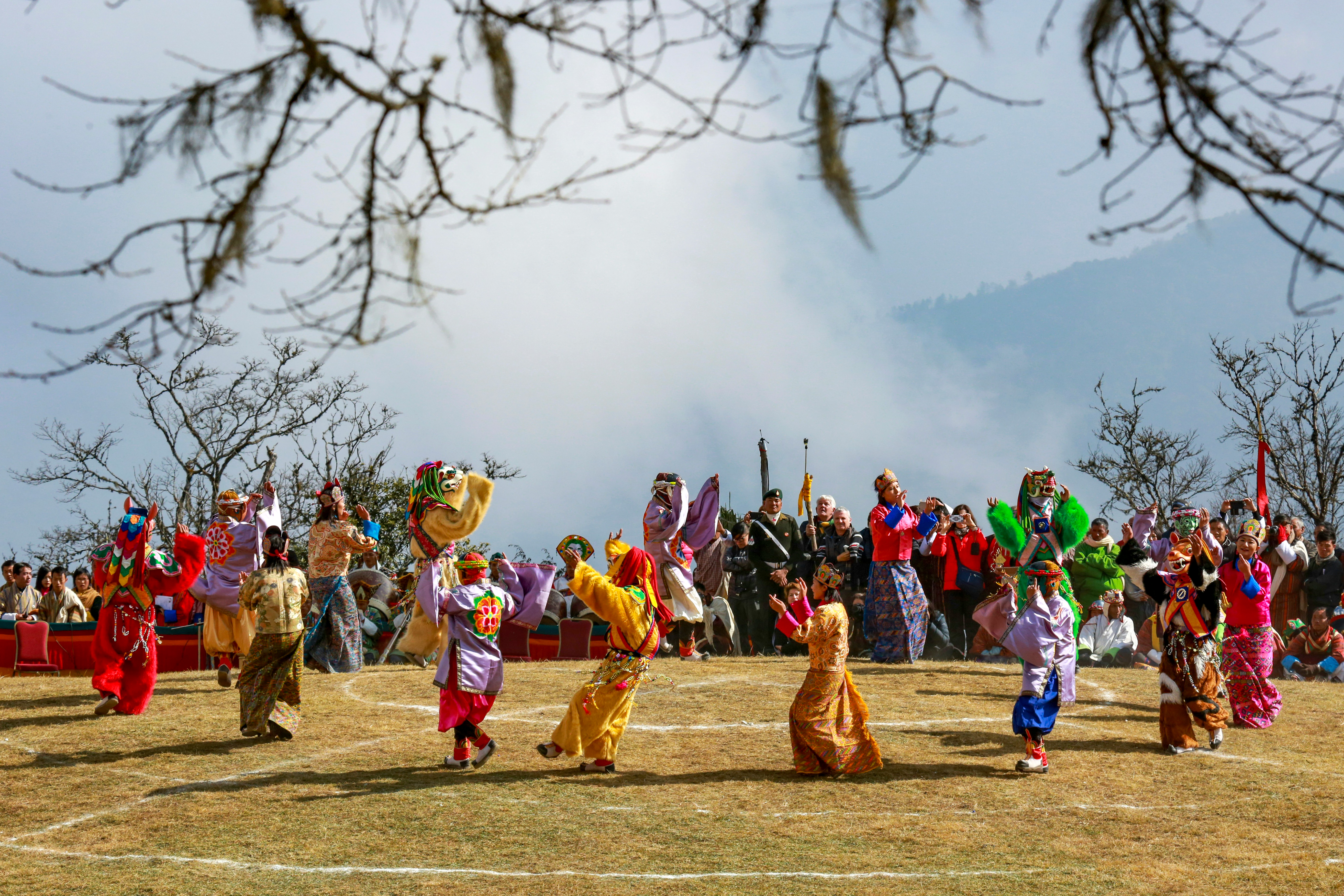
Tsechu — A festival. Bhutan’s masked dance festivals are held annually at dzongs and temples across the country — the cultural highlight of any visit.
Dress & Daily Life
Gho — The traditional knee-length robe worn by Bhutanese men, secured with a woven belt. Men wear the gho to work, to school, and to festivals.
Kira — The traditional ankle-length dress for Bhutanese women, woven from vibrant silk or cotton.
Kabney — A ceremonial scarf worn by men, wrapped around the upper body and shoulders. The colour indicates rank: white for commoners, orange for ministers, saffron for the King.
Koma — Ornate silver clips used to fasten the kira at the shoulders. Often beautifully decorated, komas are both functional and treasured heirlooms.
Hemadatsi — Bhutan’s beloved national dish: fiery chillies cooked in a rich cheese sauce, sometimes with potatoes or vegetables. No Bhutanese meal is complete without it.
Ma — Butter. In Bhutan, yak butter finds its way into tea, into lamp offerings, and into the heart of daily life.
Carry these words with you as you travel, and Bhutan will open its doors a little wider. Language, after all, is the first bridge between cultures — and in the Land of the Thunder Dragon, every word is an invitation.
Culture & Heritage
Ready to Explore Bhutan?
Let us craft your perfect Bhutanese adventure
Plan Your Journey