
In Bhutan, music is not something you go to hear — it comes to find you. It drifts from monastery courtyards where monks chant at dawn, rises from valley floors where farmers sing while planting rice, and fills the air at every festival where masked dancers whirl to the beat of ancient drums. The origin of music, according to Buddhist texts, is attributed to Lhamo Yangchenma — the goddess Sarasvati — and when you hear a Bhutanese bamboo flute echoing between mountain ridges, you begin to understand why music in this kingdom has always been considered sacred.
Two Melodic Styles
Bhutanese music is built upon two distinct styles. Yangring uses a longer, more expansive melody, common when singing spiritual and classical songs — the kind of music that fills temple halls and echoes against stone walls. Yangthung, the shorter melodic form, is the foundation of boedra, the elegant court songs that have accompanied Bhutanese ceremony and celebration for centuries. Together, these two styles create a musical spectrum that ranges from the deeply devotional to the joyfully communal.
Sacred Music and Cham Dance
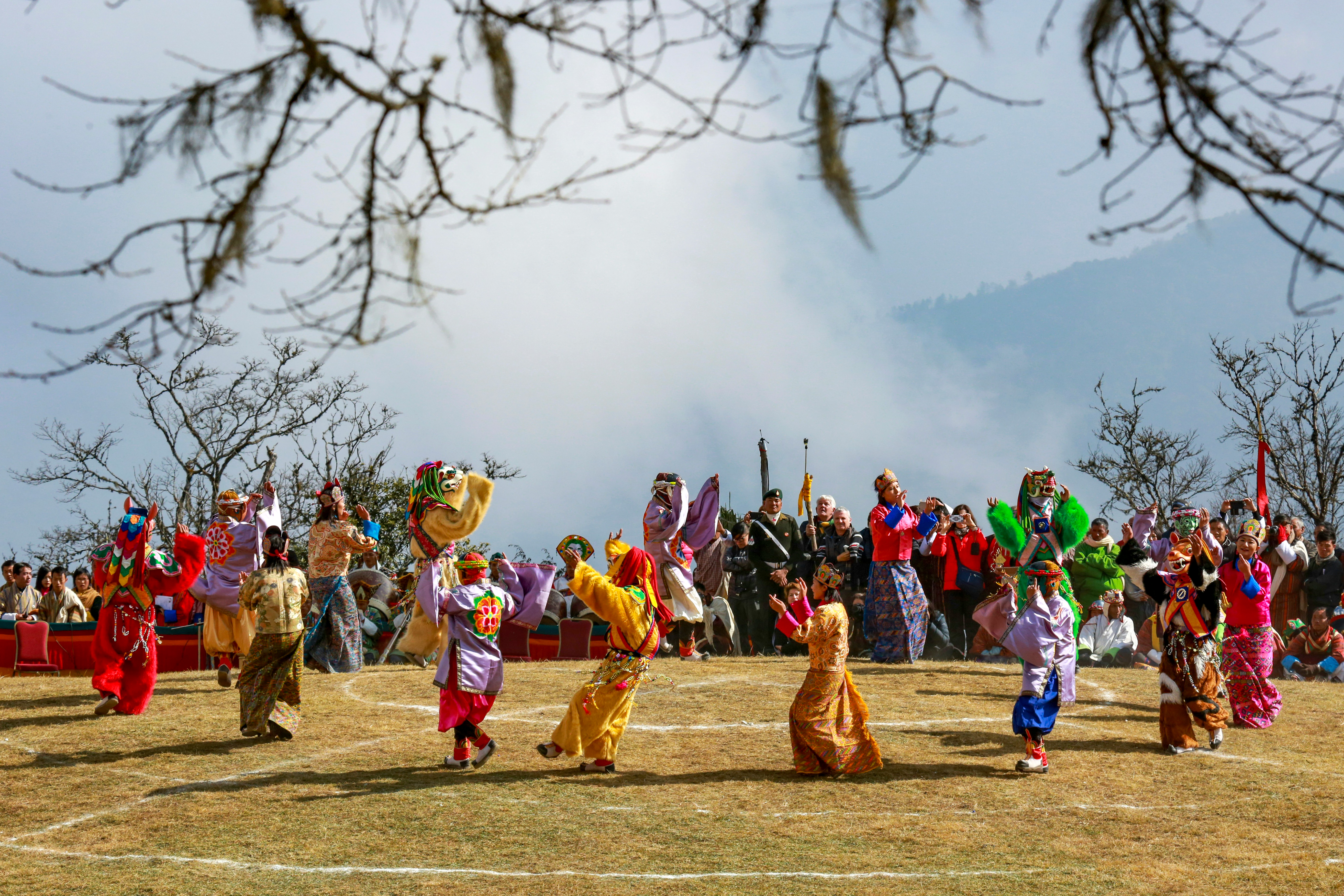
The religious music of Bhutan is most often chanted, with lyrics and dances that re-enact namtars — spiritual biographies of Buddhist saints — performed in distinctive masks and costumes. These sacred songs are written in Chöke, classical Tibetan, the liturgical language of Bhutanese Buddhism. Central to every tsechu festival is the Cham dance — a vibrant, mesmerising performance where masked dancers move to sacred music in patterns believed to bring spiritual merit to everyone who witnesses them. To watch a Cham dance is not merely to observe — it is to participate in an act of collective blessing.
Folk Music
Bhutanese folk music draws deeply from Drukpa Buddhist traditions, with chanting styles rooted in sacred practice. Most folk song authors remain anonymous — their melodies passed down through generations as communal property rather than individual creations. Lyrics are most often in literary Dzongkha or Chöke, though traditional songs also exist in Khengkha and Bumthangkha, the languages of central and eastern Bhutan. Masked dances are a common component, blurring the line between folk entertainment and spiritual devotion.
Traditional Instruments
Drangyen (Lute) — The oldest instrument in Bhutan, and perhaps the most visually striking. The drangyen is a long lute painted red, green, and blue, crowned with a dragon or crocodile head carved at the top. Its name means “melodious sound,” and it has seven strings — which, according to Bhutanese belief, belong to the seven dakinis, celestial beings from the heavenly realms.
Piwang (Fiddle) — A two-stringed instrument played with a bow, the piwang has a rounded, cylindrical resonance box covered with thin animal skin. Its mournful, haunting tone provides the emotional backbone of many traditional songs.
Lim (Bamboo Flute) — With six holes and a sound that carries across valleys, the lim is probably the most popular of all Bhutanese instruments, prized for its accessibility and its ability to evoke the landscape itself. The sentimental flute piece above, performed by Tashi Wangdi, captures the lim’s distinctive voice.
Yangchen (Hammered Dulcimer) — A stringed board instrument painted in the traditional red, green, and blue, the yangchen produces a shimmering, percussive sound that accompanies both sacred and secular music. Other traditional instruments include the kongtha, dung (long horn), jaling (oboe), nga (drum), and kangdung (thighbone trumpet).
Music in Bhutan is not a separate art form — it is the thread that runs through ritual, celebration, labour, and love. The Bhutanese put music into every aspect of life: to observe their most sacred ceremonies, to celebrate and socialise, and to transmit knowledge, experience, and values to the next generation. To hear it is to hear the heartbeat of a culture that has always understood that melody and meaning are inseparable.
Culture & Heritage
Ready to Explore Bhutan?
Let us craft your perfect Bhutanese adventure
Plan Your Journey