
They are the first thing you see when you arrive in Bhutan, and the last thing you remember when you leave: long strings of coloured cloth streaming from mountain ridges, draped across bridges, clustered on poles above rooftops, whipping in the wind at every pass and sacred site. Prayer flags are the visual heartbeat of Bhutan — so ubiquitous that the landscape would feel incomplete without them. But these are not mere decoration. Each flag carries sacred mantras printed on cloth, and each gust of wind that catches them is believed to carry those blessings across valleys, rivers, and mountains to every living being in its path.
Types of Prayer Flags
While united by their sacred purpose, Bhutanese prayer flags take many forms, each reflecting local customs and specific intentions.
Lungdar — The square or rectangular coloured flags hung horizontally or diagonally, connected along their top edges on strings between wooden poles or ropes. These are the most ubiquitous prayer flags in Bhutan — strung at mountain passes, across bridges, around monasteries and stupas. Their designs range from the universal “Om Mani Padme Hum” to mantras like “Vajra Guru” for overcoming obstacles or prayers to increase one’s lung-ta — the wind-horse of fortune.
Dachog (Darshing) — Tall vertical flags clustered on poles planted directly into the earth, often found in groups around mountains and at the edges of forests. They stand like sentinels, catching the wind from every direction.
Manidar — Tall white vertical flags raised singly on poles, typically hoisted after someone has passed away as a remembrance for the deceased. Raising 108 manidar — an auspicious number in Buddhism — is considered an especially blessed act, though even one carries profound meaning.
Lhadar — Large, tall vertical flags bearing printed mantras such as “Om Mani Padme Hum.” Displayed at important monasteries and palaces, they represent victory over evil forces and are often topped with a Gyeltshen banner rather than the traditional sword, sun, and moon emblems. Today, many people hoist one grand lhadar rather than many smaller flags.
Goendar — Small white rectangular flags placed atop traditional homes, with ribbons of green, red, yellow, and blue adorning the edges. They call blessings of welfare, prosperity, and harmony upon the family within.
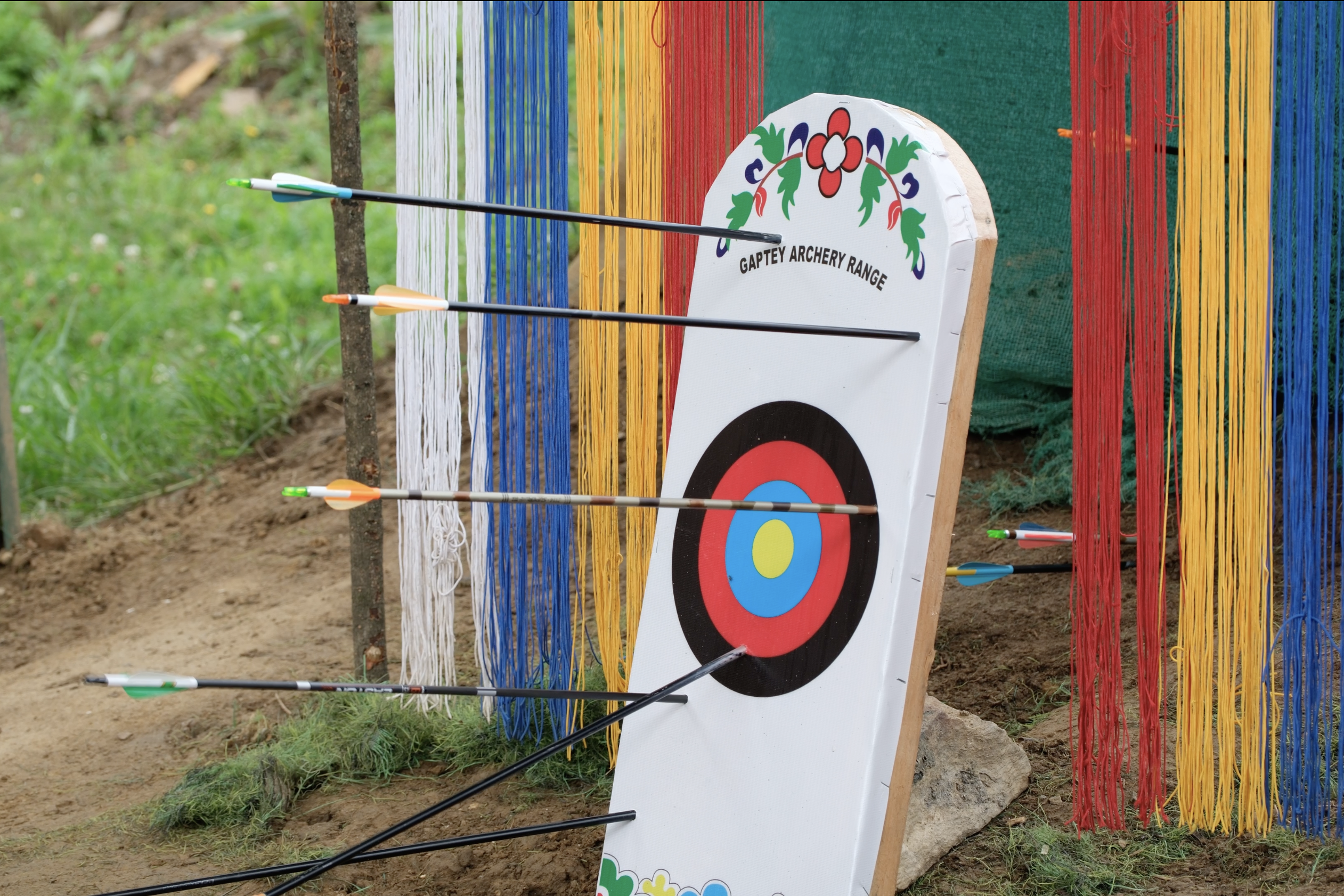
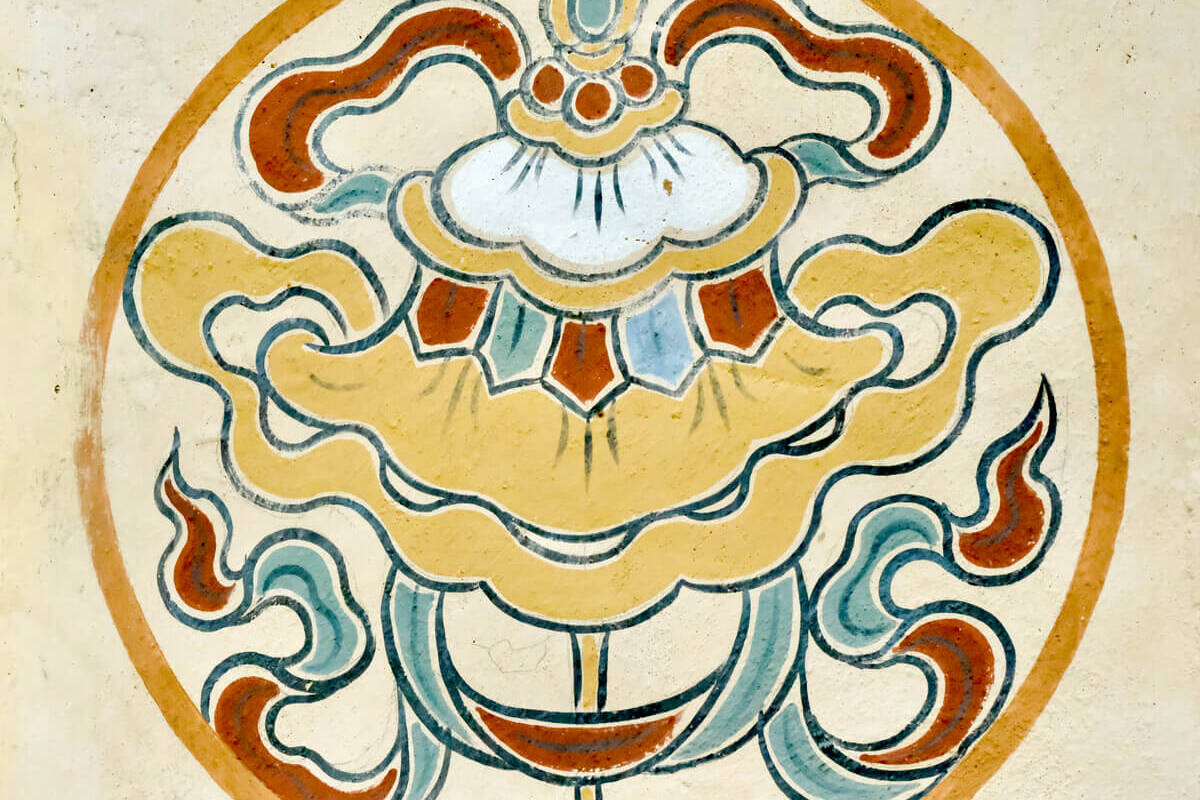
Gyeltshen Tsemo Banner — A cylindrical banner printed with mantras and the Eight Auspicious Signs, used in rituals and religious processions as a proclamation of victory over evil. It even appears at archery competitions after a match — proof that in Bhutan, sport and spirituality are never far apart.
The Symbolism of Colour
The five colours of prayer flags are not chosen at random — each represents one of the five elements and carries its own emotional and spiritual resonance. Blue evokes the sky and good health. White embodies air and purity. Red represents fire and the fulfilment of heartfelt wishes. Green symbolises water and compassion. Yellow connects to earth and the victorious overcoming of challenges. Even the small stripes on each flag echo these five colours and elements.
At the top of the Bhutanese flagpole, a sword signifies the wisdom of Mañjuśrī, resting upon a sun and moon disc, with a lotus flower and a wheel (khorlo) below — every detail loaded with meaning.
How Prayer Flags Are Made and Raised
The creation of prayer flags is itself a spiritual act. Printers produce the flags in a consecrated space through meticulous methods, ensuring that every sacred syllable appears flawlessly. Once complete, the flags are hoisted at spiritually resonant locations — high mountain passes, monastery courtyards, village rooftops — to catch the winds and carry blessings far across the landscape.
Proper orientation matters deeply: flags should hang neither crooked nor upside down, raised with intentional respect. In keeping with Buddhist values, environmentally friendly biodegradable materials honour the natural world through which the prayers travel. Some flags are formally consecrated through ritual before or after raising, though the sacred words are believed to hold power from the moment they are printed.
When the mantras inevitably fade from sun and wind exposure, the old flags are ceremonially retired through sacred burning rites — their spiritual energies released before new strings take their place. This cycle of raising, fading, and renewal has continued without interruption for as long as the Himalayas have towered over these valleys.
The Intention Behind Every Flag
For the Bhutanese, hoisting a prayer flag is an act of sincere devotion. The intention is for the dharma’s blessings to be carried across every land and through every sky — reaching every village, valley, river, and mountain — pacifying suffering and allowing all beings, whether on land, in water, or in air, to attain happiness and enlightenment.
Stand at any mountain pass in Bhutan, close your eyes, and listen. The sound you hear — that constant flutter and snap of cloth in the wind — is not just fabric moving in the breeze. It is the sound of thousands of prayers being spoken simultaneously, carried by the wind to places you cannot see, touching lives you will never know. That is the power of a prayer flag, and that is the soul of Bhutan.
Culture & Heritage
Ready to Explore Bhutan?
Let us craft your perfect Bhutanese adventure
Plan Your Journey